A supersized kangaroo, standing about 3 meters tall and weighing over 200 kilograms, a massive ancestral duck (or ostrich, it is still debated), over 2 meters tall, a wombat the size of a rhino and the largest marsupial ever to walk the earth, aptly named: ‘pouch lion’. These are but a few of the giants that roamed Australia until the late Pleistocene (~125 to ~12 thousand years ago).
This was also the home of one of the largest lizards that have ever existed, Megalania, a monster over 5 meter long, looking similar to a very large Komodo dragon.
None of these animals survive today. Most of Australian megafauna appears to have survived until 51 to 40 thousand years ago after which they suddenly disappeared.
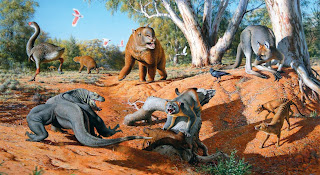 |
| Artist impression of past Australian megafauna, Roberts&Brook 2010, Science. |
Extinction Factors
Estimated is that early aboriginal ancestors arrived in Australia between 60 and 45 thousand years ago. Could human impact be the driver behind the demise of the giants? It is likely.
Giant animals breed very slowly, so disturbance of the balance is easy. Even the hunting of juveniles at a rate of one kill per person per decade, something called ‘imperceptible overkill’, could have been the cause. Also, humans are known to disturb habitat, most likely by burning vegetation in this case.
On the other hand, it might have been climate change after all. Australia was drying up during that time. It had been since eight million years ago. The problem is that a dry climate is perfect for creating large lizards and combined with the ever expanding size of their prey, prehistoric Australian lizards got beefier over time – culminating in the titanic Megalania.
Also, the Australian megafauna was well adapted to dry conditions, having survived repeated droughts, before they disappeared during a period with a relatively benign climate.
Climate, humans, both or a third unknown reason? The jury will be out on this one for a while. What is certain though, is that since September 2009 Megalania is not the only ancient supersized lizard in Australia anymore.
Megalania Family
Scott Hocknull, senior curator of geosciences at Australia's Queensland Museum, studied three fossilised bones found in Western Timor Island, part of Indonesia. He was astounded to find that the bones were belonging to a 4 meter long lizard, but neither belonging to a Komodo dragon nor to a Megalania. The bones are dated to the middle of the Pleistocene period, which means the lizard lived alongside both other large giants. More fossils and more study will confirm whether it is indeed a new species.
This new analysis also showed several Komodo dragon bones, at least 300.000 years old have recently been found in Australia. The study reveals that this, among other evidence, builds a strong case for Komodo dragons having originated and evolved their giant size in Australia along the other lizard giants.
How the Komodo dragon managed to survive in Indonesia while it disappeared in its native country where all other megafauna also got extinct is another riddle.
New Blood
A riddle that just got a little more complicated again. In the beginning of April 2010 a new study of the University of Kansas reported of the finding of a new giant lizard species, Varanus bitatawa. In a heavy populated area in the Philippines this monitor lizard of about 2 meter long has managed to remain hidden for science until 2009.
 |
| A Varanus bitatawa lizard on its home island of Luzon in the Philippines. Photograph by Joseph Brown for National Geographic |
But while scientists weren’t aware of its existence, it didn’t come as a surprise for the local tribe who have been hunting the animal for meat as a delicacy. This was also what tipped the researches off in 2001 when they saw photographs of the hunters with their prey.
The team thinks it likely that there are more unknown monitor lizards hidden in the forests of the Philippines. Hopefully they can be found before the disappearing rain forest habitat is completely gone, including its inhabitants.
These large lizards are very likely to be related to the Australian giants. They may be able to shine a light on what triggered the extinction event the other megafauna has experienced and how these remaining species have survived.